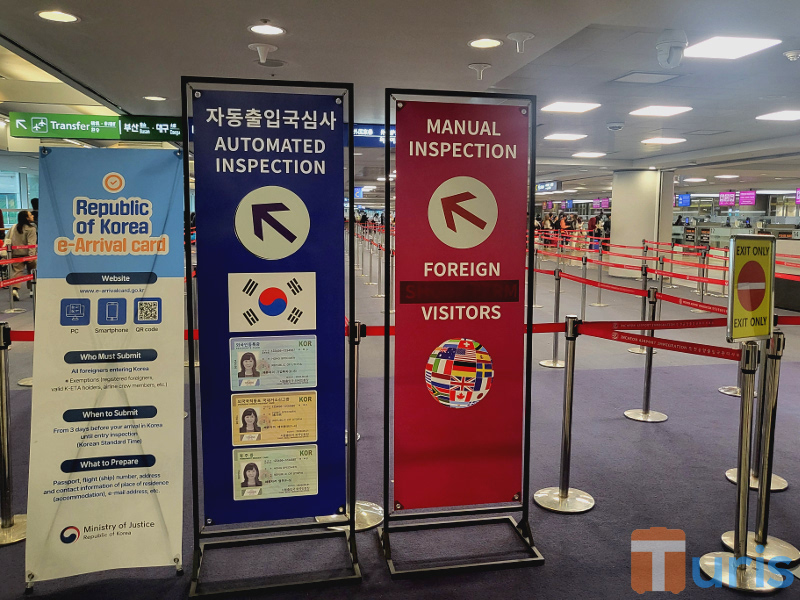
In 2025, South Korea welcomed 18.9 million visitors, a number that’s higher than the pre-pandemic record in 2019 at 17.5 million visitors. The country aims to increase the number further to 30 million visitors by 2030, over 60% higher than the 2025 figure, which would require an average of 10% annual growth from 2026 to 2030. To achieve the target, we believe there will be interesting development on South Korea visa policies, especially the expansion of visa exemption programs.
In this article, we summarize various visa exemption policies enacted by the South Korean government, from the general visa-free entry policy applied on citizenship basis, regional visa waiver programs, and other conditional, constraint-based visa-free policies.
Countries with Visa-Free Entry to Korea
As of April 2026, visitors from 111 countries can enter Korea visa-free. Refer to the table below for the full list of the countries whose citizens are granted visa waiver to enter South Korea.
| No | Region | Country / Special Government | Duration of Stay |
|---|---|---|---|
| 1 | Asia | Bahrain | 30 days |
| 2 | Brunei | 30 days | |
| 3 | Hong Kong | 90 days | |
| 4 | Israel | 90 days | |
| 5 | Japan | 90 days | |
| 6 | Kazakhstan | 30 days | |
| 7 | Kuwait | 90 days | |
| 8 | Macao | 90 days | |
| 9 | Malaysia | 3 months | |
| 10 | Oman | 30 days | |
| 11 | Qatar | 90 days | |
| 12 | Saudi Arabia | 30 days | |
| 13 | Singapore | 90 days | |
| 14 | Taiwan | 90 days | |
| 15 | Thailand | 90 days | |
| 16 | Turkiye | 90 days | |
| 17 | United Arab Emirates | 90 days | |
| 18 | Europe | Albania | 30 days |
| 19 | Andorra | 30 days | |
| 20 | Austria | 90 days | |
| 21 | Belgium | 3 months | |
| 22 | Bosnia-Herzegovina | 30 days | |
| 23 | Bulgaria | 90 days | |
| 24 | Croatia | 90 days | |
| 25 | Cyprus | 30 days | |
| 26 | Czech Republic | 90 days | |
| 27 | Denmark | 90 days | |
| 28 | Estonia | 90 days | |
| 29 | Finland | 90 days | |
| 30 | France | 90 days | |
| 31 | Germany | 90 days | |
| 32 | Greece | 3 months | |
| 33 | Holy See | 30 days | |
| 34 | Hungary | 90 days | |
| 35 | Iceland | 90 days | |
| 36 | Ireland | 90 days | |
| 37 | Italy | 90 days | |
| 38 | Latvia | 90 days | |
| 39 | Liechtenstein | 3 months | |
| 40 | Lithuania | 90 days | |
| 41 | Luxembourg | 3 months | |
| 42 | Malta | 90 days | |
| 43 | Monaco | 30 days | |
| 44 | Montenegro | 30 days | |
| 45 | Netherlands | 3 months | |
| 46 | Norway | 90 days | |
| 47 | Poland | 90 days | |
| 48 | Portugal | 90 days | |
| 49 | Serbia | 90 days | |
| 50 | Romania | 90 days | |
| 51 | Russia | 60 days | |
| 52 | San Marino | 30 days | |
| 53 | Slovakia | 90 days | |
| 54 | Slovenia | 90 days | |
| 55 | Spain | 90 days | |
| 56 | Sweden | 90 days | |
| 57 | Switzerland | 3 months | |
| 58 | United Kingdom | 90 days (British citizen), 30 days (other British nationals) | |
| 59 | America / Oceania | Antigua and Barbuda | 90 days |
| 60 | Argentina | 90 days | |
| 61 | Australia | 90 days | |
| 62 | Bahamas | 90 days | |
| 63 | Barbados | 90 days | |
| 64 | Brazil | 90 days | |
| 65 | Canada | 6 months | |
| 66 | Chile | 90 days | |
| 67 | Colombia | 90 days | |
| 68 | Costa Rica | 90 days | |
| 69 | Dominica | 90 days | |
| 70 | Dominican Republic | 90 days | |
| 71 | Ecuador | 90 days | |
| 72 | El Salvador | 90 days | |
| 73 | Fiji | 30 days | |
| 74 | Grenada | 90 days | |
| 75 | Guatemala | 90 days | |
| 76 | Guyana | 30 days | |
| 77 | Haiti | 90 days | |
| 78 | Honduras | 30 days | |
| 79 | Jamaica | 90 days | |
| 80 | Kiribati | 30 days | |
| 81 | Marshall Islands | 30 days | |
| 82 | Mexico | 3 months | |
| 83 | Micronesia | 30 days | |
| 84 | Nauru | 30 days | |
| 85 | New Caledonia | 30 days | |
| 86 | New Zealand | 3 months | |
| 87 | Nicaragua | 90 days | |
| 88 | Palau | 30 days | |
| 89 | Panama | 90 days | |
| 90 | Paraguay | 30 days | |
| 91 | Peru | 90 days | |
| 92 | Samoa | 30 days | |
| 93 | Solomon Islands | 30 days | |
| 94 | St. Kitts and Nevis | 90 days | |
| 95 | St. Lucia | 90 days | |
| 96 | St. Vincent | 90 days | |
| 97 | Suriname | 3 months | |
| 98 | Tonga | 30 days | |
| 99 | Trinidad and Tobago | 90 days | |
| 100 | Tuvalu | 30 days | |
| 101 | USA | 90 days | |
| 102 | Uruguay | 90 days | |
| 103 | Venezuela | 90 days | |
| 104 | Africa | Botswana | 90 days |
| 105 | Eswatini | 30 days | |
| 106 | Lesotho | 60 days | |
| 107 | Mauritius | 30 days | |
| 108 | Morocco | 90 days | |
| 109 | Seychelles | 30 days | |
| 110 | South Africa | 30 days | |
| 111 | Tunisia | 30 days |
As can be seen in the table, as of April 2026, visa-free entry to South Korea is applicable to citizens from 17 countries / special governments in Asia, 41 countries / special government in Europe, 45 countries in America / Oceania, and 8 countries in Africa. Liberia was also in the list but the visa-free agreement is currently suspended. Those who visit Korea from visa-free countries will obtain B-1 (Visa Exemption) or B-2 (Tourist in Transit) status during the stay in Korea.
It is important to note that even though you are from a visa-waiver country, you may need to obtain pre-approval to enter South Korea. This is since South Korean government applies travel authorization under Korea Electronic Travel Authorization (K-ETA) scheme.
K-ETA as Pre-Approval for Entry to South Korea
K-ETA (in Korean: 사전여행허가서) was first implemented on September 1, 2021, primarily as a measure to address the growing number of foreign nationals overstaying their visas or stay permit. An official web portal (K-ETA web portal) was also launched to handle the electronic travel authorization application and issuance process.
To apply for K-ETA, you simply visit the portal and create a new application. You will be guided to input various details that include your email address, passport info, and also some details about your travel to Korea. You will be charged a non refundable fee of KRW 10,000 (around $7) for your application, and you can pay with credit card. Your K-ETA application will then be processed within 72 hours after submission.
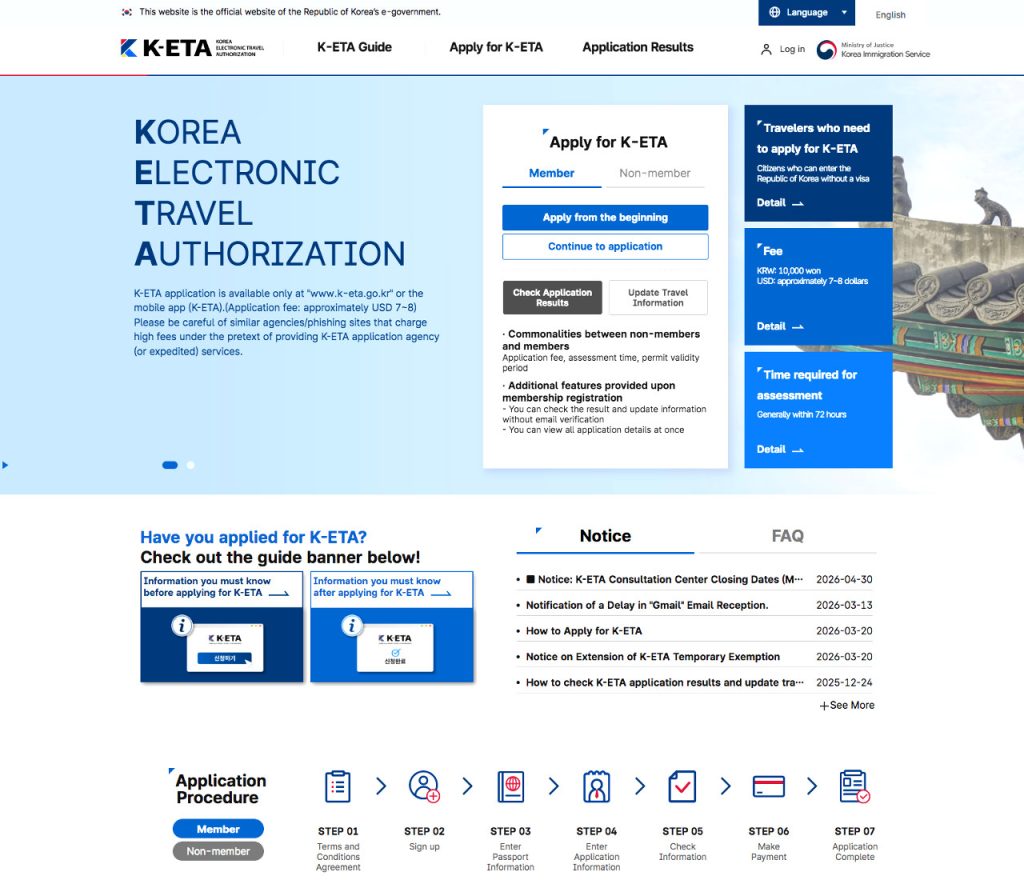
After your K-ETA is issued, it will remain valid for 3 years or until your passport expires, whichever comes first. You can use your K-ETA multiple times as long as it is still valid. So, when you visit Korea the next time, a new K-ETA application is not needed as long as you still have a valid K-ETA document.
Another benefit that you get with a valid K-ETA is that you don’t need to submit arrival card when entering South Korea.
K-ETA Exemption as of 2026
You may be wondering if K-ETA turns into an impediment instead of an incentive for those who plan to visit South Korea. To attract more visitors to Korea, the South Korean government introduced a series of K-ETA exemption policies to alleviate perceived disincentive caused by K-ETA requirement.
In 2023, the South Korean government announced K-ETA exemption for 22 countries to be implemented from April 1, 2023 to December 31, 2024. In December 2024, the Korean government through Ministry of Foreign Affairs (MOFA) announced one year extension of K-ETA exemption from January 1, 2025 to December 31, 2025. More recently, in December 2025, it was announced that K-ETA exemption would be extended for another year, which is from January 1, 2026 to December 31, 2026. The list of countries that are exempted for 2026 is the same with the original announcement in 2023.
If you are from a country that is included in the K-ETA exemption countries / special regions below, you don’t need K-ETA for visiting South Korea:
– Asia: Hong Kong, Japan, Macao, Singapore, Taiwan
– America: Canada, United States (including Guam)
– Europe: Austria, Belgium, Denmark, Finland, France, Germany, Italy, Netherlands, Norway, Poland, Spain, Sweden, United Kingdom
– Oceania: Australia, New Zealand
If you’re not from the 22 countries /special regions above but your country is in the visa-free list, you need to obtain K-ETA prior to your departure to South Korea unless you qualify for age-based exemption.
Age-based K-ETA exemption was first introduced in July 2023. The age-based exemption specifies that individuals aged 18 to 64 are required to obtain K-ETA, while those aged 17 or younger and 65 or older are exempt, regardless of the nationality. To put it another way, if you’re from a country with visa-free entry to Korea, you are automatically exempt from applying for K-ETA if you are 17 or younger, or 65 or older.
Additional K-ETA Exemption (Unannounced)
Besides the 22 countries officially exempt from K-ETA, there are more countries that are also exempt from K-ETA even though the official document is not yet released by South Korea’s Ministry of Justice. The exemption information can be found in a form of popup message that is shown to a user while filling out K-ETA application on the official K-ETA web portal.
The list of countries included on K-ETA exemption that is only available on K-ETA website (K-ETA exemption popup message) is as follows:
- Asia: Bahrain, Brunei, Israel, Kuwait, Oman, Qatar, Saudi Arabia, UAE
- Europe: Andorra, Bulgaria, Croatia, Cyprus, Czech Republic, Estonia, Greece, Holy See (Vatican), Hungary, Iceland, Ireland, Latvia, Liechtenstein, Lithuania, Luxembourg, Malta, Monaco, Portugal, Romania, San Marino, Slovakia, Slovenia, Switzerland
- America: Chile, Colombia, Mexico
- Oceania: Fiji, Kiribati, Marshall Island, Micronesia, Nauru, New Caledonia, Palau, Samoa, Solomon Island, Tonga, Tuvalu
- Africa: South Africa
Korea’s Special Visa-Free Policy
In addition to the standard visa-free policy formulated based on the country of origin, the South Korean government has also introduced special visa-free policies. These special policies usually come with certain restrictions or conditions that must be met in order to qualify.
Visa-Free Entry for Diplomatic / Government Official Passport Holders
A special visa exemption policy is implemented by the South Korean government for diplomatic or government official passport holders from some countries whose regular passport holders are required to obtain visa. The special policy also governs special period of stay for diplomats/government officials from countries with visa-free entry to Korea. The list of countries whose diplomats / government officials can visit Korea visa-free or can be granted different period of stay compared to regular passport holders is summarized in the following table.
| No | Region | Country | Duration of Stay | Passport type |
|---|---|---|---|---|
| 1 | Asia | Bangladesh | 90 days | Diplomat / gov. official |
| 2 | Cambodia | 60 days | Diplomat / gov. official | |
| 3 | China | 30 days | Diplomat / gov. official | |
| 4 | India | 90 days | Diplomat / gov. official | |
| 5 | Indonesia | 30 days | Diplomat / gov. official | |
| 6 | Iran | 3 months | Diplomat / gov. official | |
| 7 | Iraq | 30 days | Diplomat | |
| 8 | Japan* | 90 days | Diplomat / gov. official | |
| 9 | Jordan | 90 days | Diplomat | |
| 10 | Kuwait* | 90 days within 180-day period | Diplomat / gov. official | |
| 11 | Kyrgyzstan | 30 days | Diplomat / gov. official | |
| 12 | Laos | 90 days | Diplomat / gov. official | |
| 13 | Lebanon | 30 days | Diplomat / gov. official | |
| 14 | Mongolia | 90 days | Diplomat / gov. official | |
| 15 | Myanmar | 90 days | Diplomat / gov. official | |
| 16 | Oman* | 90 days | Diplomat / gov. official | |
| 17 | Pakistan | 3 months | Diplomat / gov. official | |
| 18 | Philippines | No restriction | Diplomat / gov. official | |
| 19 | Qatar* | 90 days | Diplomat / gov. official | |
| 20 | Saudi Arabia* | 90 days within 180-day period | Diplomat / gov. official | |
| 21 | Tajikistan | 90 days | Diplomat / gov. official | |
| 22 | Turkmenistan | 30 days | Diplomat / gov. official | |
| 23 | Uzbekistan | 60 days | Diplomat | |
| 24 | Vietnam | 90 days | Diplomat / gov. official | |
| 25 | Europe | Armenia | 90 days | Diplomat / gov. official |
| 26 | Azerbaijan | 30 days | Diplomat / gov. official | |
| 27 | Belarus | 90 days | Diplomat / gov. official | |
| 28 | Croatia* | 90 days | Diplomat / gov. official | |
| 29 | Cyprus* | 90 days | Diplomat / gov. official | |
| 30 | Georgia | 90 days | Diplomat / gov. official | |
| 31 | Moldova | 90 days within 6-month period | Diplomat / gov. official | |
| 32 | Ukraine | 90 days | Diplomat / gov. official | |
| 33 | America / Oceania | Argentina* | 90 days | Diplomat / gov. official |
| 34 | Belize | 90 days | Diplomat / gov. official | |
| 35 | Bolivia | 90 days | Diplomat / gov. official | |
| 36 | Ecuador* | Assignment period | Diplomat | |
| 3 months | Gov. official | |||
| 37 | Paraguay* | 90 days | Diplomat / gov. official | |
| 38 | Vanuatu | 90 days | Diplomat / gov. official | |
| 39 | Africa | Algeria | 90 days | Diplomat / gov. official |
| 40 | Angola | 30 days | Diplomat / gov. official | |
| 41 | Benin | 90 days | Diplomat / gov. official | |
| 42 | Cameroon | 90 days | Diplomat / gov. official | |
| 43 | Cape Verde | 90 days | Diplomat / gov. official | |
| 44 | Egypt | 90 days | Diplomat / gov. official | |
| 45 | Equatorial Guinea | 90 days | Diplomat / gov. official | |
| 46 | Gabon | 90 days | Diplomat / gov. official | |
| 47 | Ivory Coast | 90 days | Diplomat / gov. official | |
| 48 | Mozambique | 90 days | Diplomat / gov. official | |
| 49 | Tanzania | 90 days within 180-day period | Diplomat / gov. official |
* Visa-free entry for regular passport holders
For diplomats and government officials from countries not covered by the special exemption policy above, the visa rules are the same as those for regular passport holders.
Jeju Visa Waiver Program
Jeju Island is a special administrative region in the southern coast of Korea. The island is famous for natural attractions such as Halla Mountain, Seongsan Ilchulbong (Sunrise Peak), Manjanggul (Manjang Cave), Jeongbang Waterfall, among others. In 2022, a special act was passed to allow visa-free entry to Jeju Island starting on June 1, 2022.
With the special act, international visitors especially those who are normally required to obtain visa to enter Korea, can visit Jeju Island visa-free for a period of up to 30 days under B-2 (Tourist in Transit) status. Visitors should only stay in Jeju Island to benefit from the visa-free status. If the visitor plans to visit other region in Korea during the trip, visa may be required in accordance with the regular visa policy applied by the South Korean government for the visitor’s country of origin.
Jeju visa waiver program is not applicable for citizens from the 23 countries listed below:
- Asia: Afghanistan, Bangladesh, Iran, Iraq, Kyrgyzstan, Myanmar, Nepal, Pakistan, Palestine, Sri Lanka, Syria, Uzbekistan, Yemen
- Europe: Kosovo
- Africa: Cameroon, Egypt, Gambia, Nigeria, Senegal, Somalia, Sudan
- America / Oceania: Cuba
If your country is not in the list of 23 countries excluded from Jeju visa waiver program above and you would normally need visa to enter South Korea, you can consider visiting Jeju Island instead, as it allows visa-free entry.
Visa-Free Entry for Travelers in Transit
Visa-free entry for travelers in transit was reimplemented by the South Korean government beginning April 30, 2023 after being suspended during COVID-19 pandemic. This policy is aimed at eligible travelers who fly to a final destination with a layover or stopover in Korea. Travelers who qualify for visa-free entry through travelers in transit scheme can stay in Korea for up to 30 days under B-2 (Tourist in Transit) status.
The primary requirement for visa-free entry under “Travelers in Transit” program is to have a valid visa, long-term stay permit, or residency (including green card holder) from any of the 36 countries listed in the table below:
| No | Region | Visa Issuing Country |
|---|---|---|
| 1 | America | Canada |
| 2 | United States | |
| 3 | Oceania | Australia |
| 4 | New Zealand | |
| 5 | Europe | Austria |
| 6 | Belgium | |
| 7 | Bulgaria | |
| 8 | Croatia | |
| 9 | Cyprus | |
| 10 | Czech Republic | |
| 11 | Denmark | |
| 12 | Estonia | |
| 13 | Finland | |
| 14 | France | |
| 15 | Germany | |
| 16 | Greece | |
| 17 | Hungary | |
| 18 | Iceland | |
| 19 | Ireland | |
| 20 | Italy | |
| 21 | Latvia | |
| 22 | Liechtenstein | |
| 23 | Lithuania | |
| 24 | Luxembourg | |
| 25 | Malta | |
| 26 | Netherlands | |
| 27 | Norway | |
| 28 | Poland | |
| 29 | Portugal | |
| 30 | Romania | |
| 31 | Slovakia | |
| 32 | Slovenia | |
| 33 | Spain | |
| 34 | Sweden | |
| 35 | Switzerland | |
| 36 | United Kingdom |
Besides the primary long-term visa / residency requirements, there are other requirements that must be satisfied by a visitor who is interested in getting visa-free entry to Korea through “Travelers in Transit” program (Korea transit visa) as follows:
- Has a confirmed flight ticket departing from Korea within the next 30 days after entering Korea
- Not a citizen or passport holder of 23 countries that are excluded in the Jeju visa waiver program
- Has not been denied entry to South Korea in the last 3 years
- Has never been fined 5 million KRW or more for violating the law and has never been deported from South Korea
- If the traveler enters a third country prior to transiting in Korea, the transit in the third country must not exceed 3 days or 72 hours
Cases where a traveler can benefit from visa-free entry under “Travelers in Transit” program:
- A traveler flies from his/her home country with stopover in Korea to a destination country whereas he/she has a residence permit and the destination country is one of the 36 countries
- A traveler flies from an eligible country whereas he/she has a residence permit to his/her home country with stopover in Korea
- A traveler flies from a non home country to another non home country with stopover in Korea and the traveler holds a residence permit from one of the 36 countries
Concrete example: An Indian national holding US green card plans to travel to several countries through Korea.
Examples of routes where the Indian national is eligible for Korea transit visa:
- India – Korea – United States
- United States – Korea – India
- India – Japan (2 days) – Korea – United States
- Singapore – Korea – Japan
- Singapore – India (2 days) – Korea – United States
Examples of routes where the Indian national is not eligible for Korea transit visa:
- India – Korea – India
- United States – Korea – United States
- India – Hong Kong (2 days) – Korea – India
- India – Japan (5 days) – Korea – United States
- Singapore – Japan (5 days) – Korea – United States
Due to the possibility of different interpretation by the immigration officer on your planned flight route, it is recommended that you also consult the Korean embassy or consulate in your country to confirm your eligibility for the transit visa.
Visa-Free Entry for Group Tour
There are several visa-free entry policies for group tour as follows:
- Visa-free entry for Chinese tourists in a group tour to Jeju Island by entering Korea through other airports
- Visa-free entry for Chinese tourists holding Japan group tour visa with transit through Korea
Visa-Free Entry for Chinese Tourists To Jeju Island in a Group Tour
Chinese tourists departing from China including Hong Kong and Macao to Jeju Island with arrival at designated airports in Korea, may enter Korea visa-free. The allowed transit time after arrival is up to five days before departing to Jeju Island. The areas that can be visited are restricted, depending on the airport of arrival. The airport for departure is also restricted as summarized in the table below:
| Airport of Arrival | Allowed Areas to Visit During Transit | Allowed Airports for Departure |
|---|---|---|
| Incheon Airport, Gimpo Airport | Seoul Metropolitan Area (Seoul, Incheon, Gyeonggi Province), Gangwon Province | Incheon Airport, Gimpo Airport, Jeju Airport, Yangyang Airport |
| Gimhae Airport (Busan), Daegu Airport | Busan, Daegu, Ulsan, North Gyeongsang Province, South Gyeongsang Province, Seoul Metropolitan Area | Gimhae Airport, Daegu Airport, Incheon Airport, Gimpo Airport, Jeju Airport |
| Yangyang Airport | Gangwon Province, Seoul Metropolitan Area | Yangyang Airport, Incheon Airport, Gimpo Airport, Jeju Airport |
| Cheongju Airport | Daejeon, Sejong, North Chungcheong Province, South Chungcheong Province, North Jeolla Province, Seoul Metropolitan Area | Cheongju Airport, Incheon Airport, Gimpo Airport, Jeju Airport |
| Muan Airport | Gwangju, North Jeolla Province, South Jeolla Province, Seoul Metropolitan Area | Muan Airport, Incheon Airport, Gimpo Airport, Jeju Airport |
Chinese tourists visiting Korea under the “Visa-free Entry for Chinese Group Tourists to Jeju” program will stay in Korea on a B-2 (Tourist in Transit) visa status with maximum stay of 15 days. The group tour operator must also be registered with Korean Ministry of Culture, Sports, and Tourism so that the tourists can be eligible for the visa-free entry program.
Visa-Free Entry for Chinese Tourists Holding Japan Group Tour Visa
Chinese tourists with valid Japan group tour visa may enter Korea visa-free when the following requirements are satisfied:
- Participate in a group tour that is registered / recognized by Korean Ministry of Culture. Sports, and Tourism
- Depart from China to Japan via Korea or from Japan to China or another country via Korea
- The transit airport in Korea is not Jeju Airport
If the requirements are met, the visitors under the “Chinese Tourists Holding Japan Group Tour Visa” program may enter Korea visa-free on B-2 (Tourist in Transit) visa status with maximum stay of 15 days.
Summary of South Korea’s Visa-Free Entry Programs
The table below summarizes various visa-free entry programs implemented by the South Korean government:
| No | Scheme | Status of Stay | Remark |
|---|---|---|---|
| 1 | Visa-free entry based on country / citizenship | B-1 (Visa exemption) or B-2 (Tourist in transit) | Applicable to 111 countries (April 2026) |
| 2 | Visa-free entry for diplomatic / official passport holders | A-1 (Diplomat) or A-2 (Official) | Special visa-free entry policy to diplomats and officials from 49 countries |
| 3 | Jeju visa waiver program | B-2 (Tourist in transit) | Not applicable to passport holders from 23 countries |
| 4 | Visa-free entry for travelers in transit | B-2 (Tourist in transit) | Applicable to visitors with long-term visa / stay permit / residency issued from 36 countries, provided they are not citizens of 23 countries excluded from the Jeju visa waiver program |
| 5 | Visa-free entry for group tour | B-2 (Tourist in transit) | Applicable to Chinese nationals visiting Jeju in a group tour or holding Japan group tour visa |
Besides the programs listed in the table above, there are other visa-free entry initiatives that are not yet legally formalized, for example visa-free entry for Indonesian group tourists that is currently running as a pilot program.
Frequently Asked Questions
Q: Can I enter Korea if my country is in the list of visa-free countries to Korea?
A: Only if your country is also in the K-ETA exemption list. If your country is not in the K-ETA exemption list, you need to apply for K-ETA to get pre-approval to enter Korea
Q: I am a US citizen. Should I apply for K-ETA when visiting Korea?
A: United States is in the list of K-ETA exemption. You don’t need to apply for K-ETA. However, you will be required to submit arrival card upon your arrival in South Korea.
Q: I am a US citizen and I already have my K-ETA. Do I still need to submit an arrival card when I arrive in South Korea?
A: No, you don’t need to submit arrival card when arriving in South Korea as long as your K-ETA document is still valid.
Q: I am a Filipino living in Philippines. Can I enter Korea visa-free?
A: As a Filipino, you are required to obtain visa to enter Korea. However, there are some cases where you can enter Korea visa free: 1) You travel to Jeju Island and immediately return to Philippines or 2) You have a valid visa from 36 designated countries.
Q: I am a Filipino holding US green card. I plan to travel home to Philippines from United States with layover in Korea. Can I enter Korea during my layover?
A: If your flight route is United States – Korea – Philippines, you can enter Korea visa-free during your layover for up to 30 days under “Travelers in Transit” program.
Q: I am a Filipino holding US green card. I plan to travel home to Philippines from United States through Korea. I already have my United States – Korea ticket. I plan to buy Korea – Philippines ticket after arriving in South Korea. With this plan, am I eligible for Korea transit visa?
A: You’re not eligible since you don’t have a confirmed flight ticket departing from Korea. If you want to be eligible, you need to have the ticket(s) for United States – Korea and Korea – Philippines (either a single ticket or separate tickets) before you leave for Korea from United States.
Related posts:
 Traveling to Korea: How to Fill out Korea Arrival Card
 How to Submit Korea e-Arrival Card as Required Document for Entry to South Korea
 Airlines and Check-in Counters at Incheon Airport Terminal 2
 Q-Code Requirements for Entry to Korea as of October 2025
 Review: Asiana Business Lounge East at Incheon Airport Terminal 1
 Q-Code Requirements for Entry to Korea as of April 2026